What if the computer only gave the instructions?
For Study 003, I wanted to move away from using code to create the finished image.
Instead, the computer would simply tell me what to do.
The Processing sketch creates an invisible square grid. Each position in the grid is randomly assigned one of seven possible instructions:
.↓      Colour 1 / down
..↓     Colour 2 / down
...↓    Colour 3 / down

.→      Colour 1 / right
..→     Colour 2 / right
...→    Colour 3 / right

blank   No mark
The number of dots tells me which of three brush pen colours to use, while the arrow tells me whether to make the mark horizontally or vertically.
That’s all the computer decides.

Random within rules
Unlike the previous two studies, there isn’t a mathematical relationship between one grid position and the next.
Processing randomly chooses from the seven possible outcomes:
int outcome = int(random(7));This means every generated sheet is different, but the randomness is still tightly controlled. The computer can only choose from the rules I’ve given it.
Adding the blank or null instruction turned out to be particularly important. Without it, every position had to contain a mark and the results became very dense. Empty cells introduce gaps and allow irregular areas of white space to form naturally.

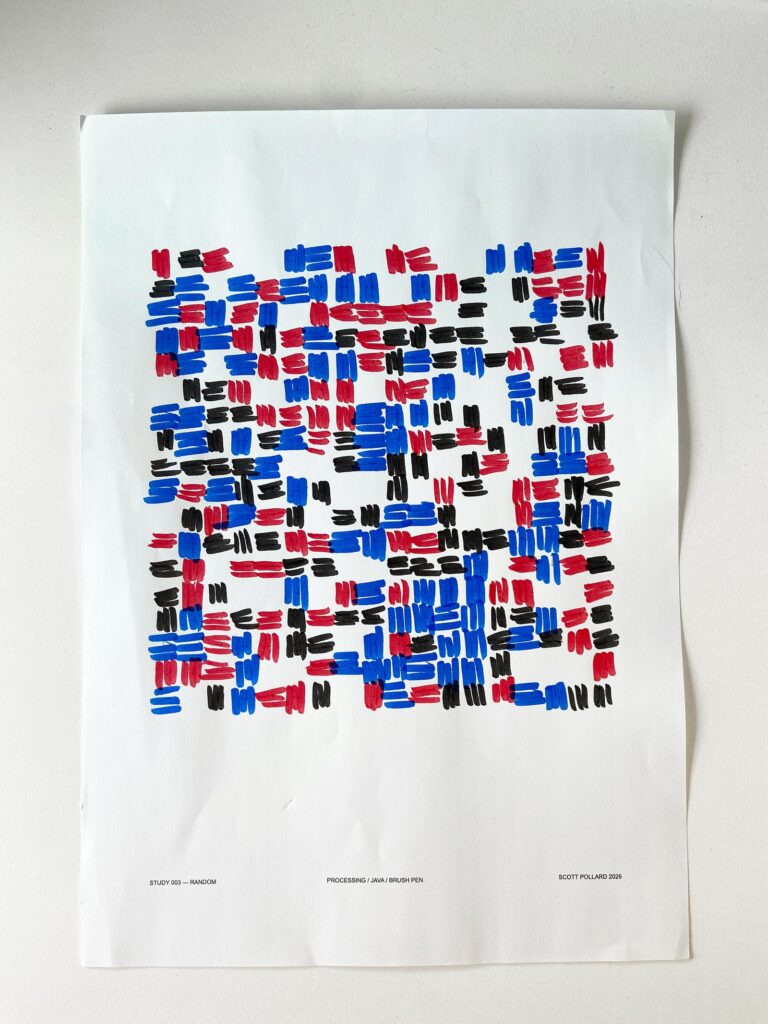

From code to paper
I printed the generated instructions onto A4 paper in a very light grey and then worked through the grid by hand with three brush pens.
This is where the computer loses control.
The algorithm determines the colour, position and direction, but it can’t determine exactly how I make the mark. Pressure changes. Lines aren’t perfectly straight. Some strokes are wider than others. Colours behave differently on the paper.
Repeating the same generated process with different sets of three colours also produces surprisingly different results.
What starts as a rigid grid of random computer instructions becomes something much less precise once it’s interpreted by hand.
For me, that’s the interesting part of this study: the code creates the rules, randomness creates the composition, and the hand creates the final image.
