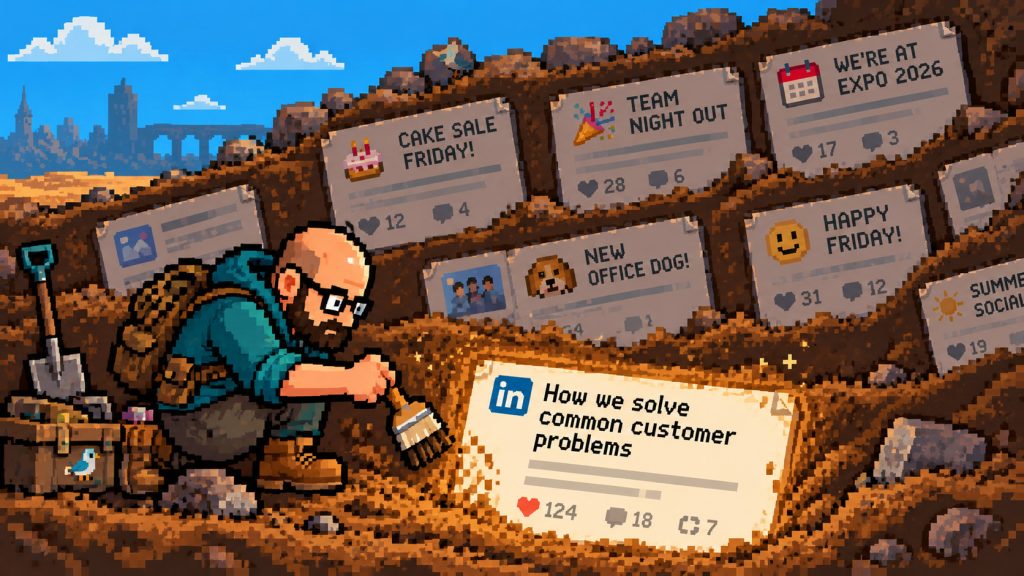
The usual advice is to post regularly. Keep the feed active. Talk about what you’re doing. Promote the next event. Share the cake sale. Post some photos from the office.
There’s nothing particularly wrong with any of that.
But most of it has a very short shelf life.
A post promoting an event next Tuesday isn’t particularly useful on Wednesday. An offer ending this month isn’t much use next year.
As AI starts changing how we find businesses and information online, I think there’s an argument for businesses putting more effort into the things that don’t expire.
Social media is part of your business’s footprint
For years we’ve thought about Google when deciding what information businesses should publish online.
We build service pages. We write articles. We optimise websites.
But people are increasingly asking AI assistants the sorts of questions they previously typed into Google.
“Who can help me with this?”
“What companies specialise in that?”
“What’s the difference between these services?”
“Which businesses have experience working with companies like mine?”
That changes things slightly.
An AI system trying to answer those questions needs information to work with.
Your website is obviously part of that. But your wider presence online can potentially contribute too, depending on what information an AI service can access, index or retrieve.
Social media therefore doesn’t necessarily have to be thought of purely as a feed.
It can be part of the information that exists about your business.
What does the internet actually know about your company?
That’s an interesting question for any business to ask.
Imagine someone had never heard of your company before.
Could they work out what you’re particularly good at?
Could they understand the problems you solve?
Could they tell who your customers are?
Could they understand why someone might choose you rather than a competitor?
And importantly, is that information actually written down somewhere publicly accessible?
A business might have decades of experience locked inside the heads of its employees while its social media accounts mostly contain Christmas opening hours and photographs from networking events.
That’s quite a strange imbalance when you think about it.
This doesn’t mean posting every day
This is actually where I think AI could make social media slightly more manageable for smaller businesses.
You don’t necessarily need to become a content machine.
Instead of worrying about finding something to publish every morning, spend some of that time creating useful evergreen content.
Explain something customers regularly misunderstand.
Answer a common question.
Talk about how you approach a particular problem.
Explain why your industry works the way it does.
Share some knowledge from someone who has worked in the business for twenty years.
Talk about a customer problem you’ve solved.
Explain something that genuinely differentiates you from competitors.
One useful post a week might tell the internet considerably more about your business than five disposable updates.
Build a library, not just a feed
Perhaps that’s the bigger shift.
Instead of thinking:
“What can we post today?”
Think:
“What should somebody be able to learn about our business?”
Then start filling in the gaps.
Over time, your social channels become something more useful. There’s a post demonstrating your expertise in one area.
Another explaining a service.
Another answering a difficult customer question.
Another showing how you approach a problem.
Another containing insight from someone within the company.
Six months later, those posts haven’t necessarily lost their value.
You’ve gradually created a public library of information about the business.
The audience might arrive much later
This is the bit I find particularly interesting.
We’re accustomed to judging social posts almost immediately.
How many impressions?
How many likes?
How many comments?
Did anyone click?
Those numbers aren’t meaningless, but perhaps they’re no longer the complete measure of whether something was worth publishing.
The person who eventually benefits from something you publish today might not see the original post at all.
They might encounter the information through search.
They might find it while researching your company.
Or increasingly, an AI assistant might retrieve information from across the web while trying to answer their question.
That doesn’t mean we should start filling social media with content written for robots.
Quite the opposite.
It means businesses have another reason to publish genuinely useful information about what they know.
Give AI something useful to find
There are plenty of unknowns around exactly how AI platforms will use social content, and access varies considerably between platforms.
But the underlying principle is fairly straightforward.
If useful information about your business doesn’t exist publicly, it can’t easily be discovered.
You don’t need to post five times a day.
You don’t need to manufacture opinions just to satisfy an algorithm.
And you probably don’t need another photograph announcing that there are cakes in the office kitchen.
Keep posting the things happening in your business.
Just make sure some of what you’re publishing will still be useful when the cakes are long gone.