Category: Thoughts

  • AI is spoiling the enjoyment of surprise

    AI is spoiling the enjoyment of surprise

    We seem to have become obsessed with how quickly things can be done. How quickly can we build the website? How quickly can we create the concept? How quickly can we write the code? And increasingly, how quickly can AI do all of the above?

    Speed has become one of the easiest ways to measure progress. If something took two days and now takes two hours, that must be better. And in plenty of situations, it absolutely is. But I’m starting to wonder whether we’ve accidentally started optimising something else out of the process.

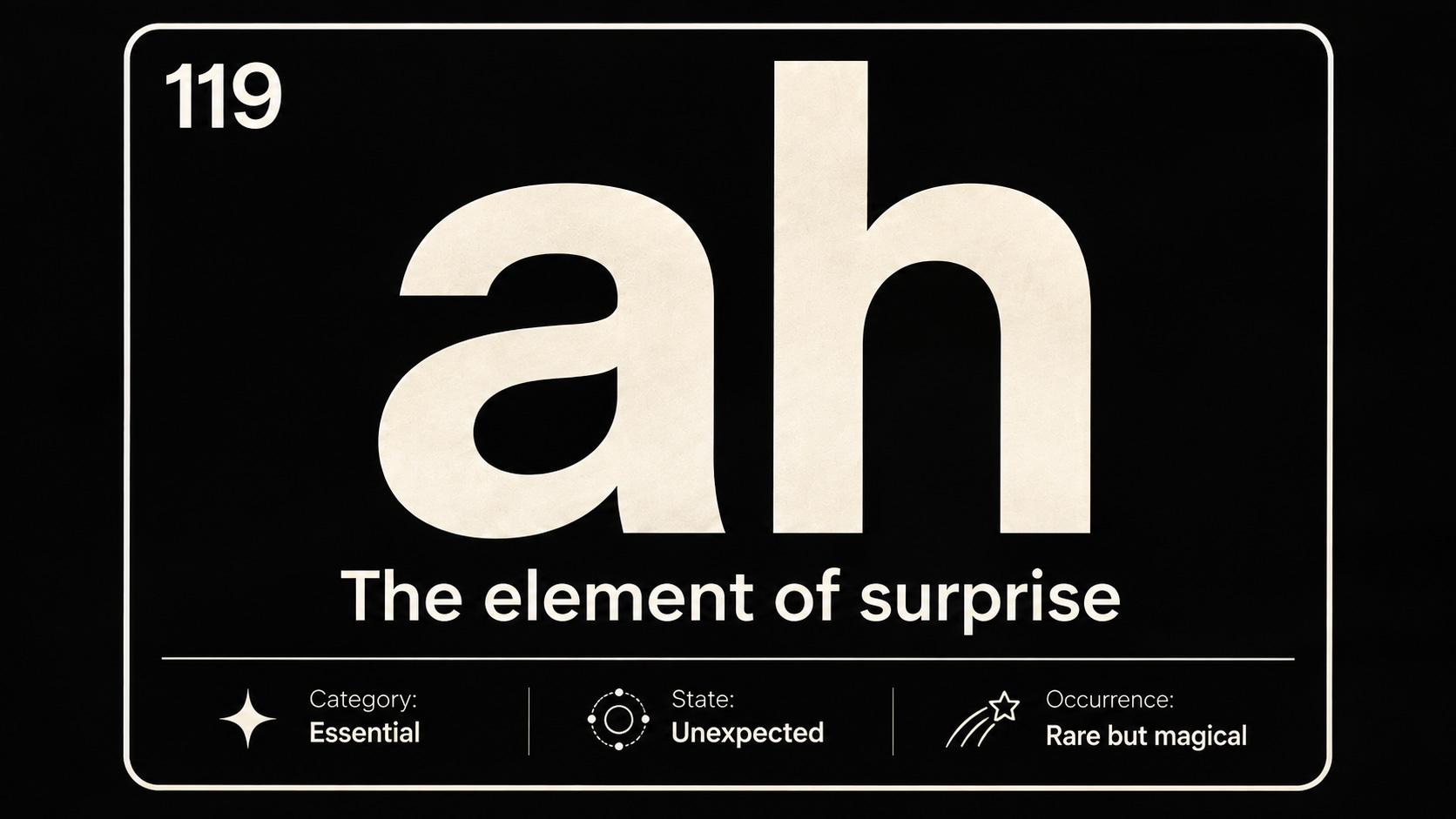
    Surprise.


    We don’t like uncertainty very much

    Most businesses are naturally built around reducing uncertainty. We create processes, make templates, automate repetitive tasks, establish best practices and look at what worked last time so we can do more of it. It makes perfect sense.

    If a problem can be solved logistically rather than creatively, logistics normally wins. Creativity introduces uncertainty. You might spend three hours exploring an idea only to discover it doesn’t work. You might write some code, run it and get an error. You might design something, leave it overnight, come back the following morning and decide it’s rubbish.

    From a productivity point of view, this isn’t particularly efficient. But perhaps that inefficiency has some value.


    I’ve probably had this thought reinforced by watching many Rory Sutherland lectures. One of the recurring ideas I’ve taken from his work is that we’re very good at valuing things we can logically explain and measure. Efficiency is easy to defend in a meeting. Spending an afternoon experimenting with something that might go nowhere is rather harder.


    Ludwig von Mises wrote about something he called the “joy of labour”. Part of that joy comes from mastering something and being able to look at the result and think: I know how to make this. There’s another part I think anyone who has spent time coding will recognise. That feeling when something finally works.

    Not because somebody handed you the answer, but because you’ve spent an hour changing things, reading documentation, breaking it, fixing it, breaking something else and eventually understanding what was wrong. The result matters, but so does everything that happened before the result.

    I’ve been thinking about this quite a lot while using AI for coding. There’s a particular little dopamine hit that comes from writing some code, hitting run and seeing something happen that you weren’t completely expecting. Sometimes it works. Sometimes it spectacularly doesn’t. Occasionally the mistake is actually more interesting than the thing you were trying to make.

    That happens in design too. Move something accidentally, try the wrong colour, crop an image strangely, misunderstand an instruction or combine two ideas that weren’t originally supposed to go together. You stop and think, actually, there’s something in that.

    Those moments are difficult to put on a project plan. They’re also some of the most interesting moments in creative work.


    Then along came “the full script please”

    I should probably admit something here. I use AI a lot.

    Over the past year I’ve used it to help me build all sorts of creative coding experiments. Generative artwork, simulations, data visualisations and interactive pieces. I’ll have an idea, describe it to ChatGPT, get some code, run it and then start experimenting.

    Make the pixels move. Add some randomness. Change the colours. What happens if gravity is added? Can we make it 3D?

    And, quite regularly:

    “The full script please.”

    (If ChatGPT starts saying replace that with this somewhere)

    It’s brilliant. An idea that might once have remained scribbled in a notebook can be running on my screen twenty minutes later. AI has opened up a creative playground for me. I can explore ideas quickly, make dozens of variations and pick out the strange, unexpected and beautiful things that appear along the way.

    I wouldn’t want to give that up.

    But there is a contradiction in there. The quicker I ask AI to solve every problem, the less time I spend understanding the problem myself. Eventually something subtle changes. I’m no longer making the thing in quite the same way. I’m directing the making of the thing.

    Those aren’t necessarily the same experience.


    Creativity needs some friction

    Steve Jobs once described creativity as connecting things. His argument was that creative people often arrive at interesting ideas because they’ve accumulated experiences and thought about them enough to make connections between them.

    I think there’s something important in that. You need some dots before you can connect them, and those dots often come from doing things the slow way. Reading the documentation. Trying something that doesn’t work. Learning why it doesn’t work. Remembering a completely unrelated technique from five years ago.

    It’s about understanding enough CSS, JavaScript, PHP or whatever else you’re using to know when the obvious solution isn’t necessarily the right one. AI can jump straight to a plausible answer, but sometimes the wandering around before the answer was where we acquired the knowledge that would help us solve the next problem.

    There’s another problem with efficiency too. It encourages us to stay where things are predictable.

    Businesses understandably like repeatable outcomes. Designers develop styles. Developers use familiar frameworks. Marketing teams repeat campaigns that performed well previously. Then AI arrives with an extraordinary ability to look at everything that already exists and give us another plausible version of it.

    That can make the safe lane even safer.

    The danger isn’t necessarily that AI produces bad work. Quite the opposite. It can produce perfectly competent work incredibly quickly, and perhaps that’s the more interesting problem. If the competent answer arrives almost instantly, what makes us continue exploring?

    Why try the strange idea? Why spend an afternoon making something that might not work? Why write the awkward first version yourself?

    Efficiency tells us to stop when the problem has been solved. Creativity often asks what happens if we keep going.


    Perhaps we need slow AI

    Perhaps we don’t actually need less AI. Perhaps we need slower AI.

    I don’t mean artificially making the computer take thirty seconds to answer instead of three. That would just be annoying. I mean slowing down how we use it.

    There is already some interesting research around this idea. Researchers have explored “Reflective AI”, applying ideas from slow technology to creative education. Rather than treating AI purely as a machine for producing finished outputs, the idea is to use it in ways that encourage reflection, understanding and engagement with the process.

    I like that distinction because it changes the relationship we have with the tool.

    Imagine asking AI not to give you the finished function, but to explain what might be causing the problem. Ask for three possible approaches. Ask it to explain the part you don’t understand. Write your own version, break it and then ask AI why it broke.

    The goal changes from get me to the answer as quickly as possible to help me explore this.

    AI becomes less like a vending machine and more like someone sitting next to you while you work.


    I don’t want to give the speed back

    None of this means I want to return to development before AI. I don’t.

    AI has removed huge amounts of tedious work from my day. It helps me investigate unfamiliar code, generate starting points, debug problems and explore ideas that would otherwise require far more time than I have available.

    My everyday development work now sits somewhere between AI-assisted and traditionally written code. Sometimes I know exactly what I want and writing it myself is quicker. Sometimes AI gets me 80% of the way there. Sometimes I deliberately work through the problem because I want to understand it.

    And sometimes I just want the full script please.

    The important thing, I think, is recognising that these choices have different consequences. Saving time is useful. Learning is useful. Enjoyment is useful too.

    We’ve spent decades making computers faster. Then we made the internet faster, our workflows faster and our development tools faster. Now AI can compress hours of thinking and making into minutes. That’s an extraordinary achievement.

    But perhaps speed shouldn’t be the only measurement.

    There is value in knowing how something works. There is value in struggling with something for a while. There is value in making the wrong thing. And there is definitely value in pressing run without being entirely sure what is going to happen.

    Because sometimes the best part isn’t that it worked.

    It’s the surprise when it does.


    Acknowledgement

    A quick shout out to Rory Sutherland, whose lectures and talks I’ve really enjoyed watching online. His way of questioning our obsession with logic, efficiency and optimisation has definitely influenced some of the thinking behind this article.

    These aren’t necessarily Rory’s conclusions about AI. They’re my own thoughts, but his work certainly helped send me down this particular rabbit hole.

    References and further reading

    Ludwig von Mises, Human Action: A Treatise on Economics
    In his discussion of the “joy and tedium of labour”, Mises considers the satisfaction that can accompany work, including the pride of being able to look at something and say, essentially, “I know how to make this. This is my work.”

    Steve Jobs, interviewed by Gary Wolf, WIRED, 1996
    Jobs discusses design as something requiring genuine understanding rather than simply appearance. In the same interview he describes creativity as connecting experiences and argues that broader experiences give people more “dots” to connect.

    Rory Sutherland
    Vice Chairman of Ogilvy UK, author of Alchemy: The Surprising Power of Ideas That Don’t Make Sense, and a frequent speaker on behavioural economics, creativity and the limitations of purely rational decision-making. His talks and lectures around efficiency, logic and human behaviour were an influence on the thinking behind this article.

    Reflective AI and slow technology
    Research presented at CHI 2026 explores “Reflective AI”, looking at how deliberately slowing AI-supported creative processes can encourage reflection, understanding and creative agency rather than simply optimising for faster outputs.
  • Iteration: how do we escape it?

    Iteration: how do we escape it?

    Almost everything is an iteration of something else.

    An artist sees another artist’s work and takes something from it. A musician hears a sound and pushes it somewhere slightly different. A designer borrows a layout, a typeface, a colour combination or an idea. Architecture responds to architecture. Fashion circles back on itself. Religions develop from older beliefs, traditions and stories.

    Even the things we describe as revolutionary rarely appear from nowhere.

    They are iterations.

    And perhaps that is simply how human creativity works.

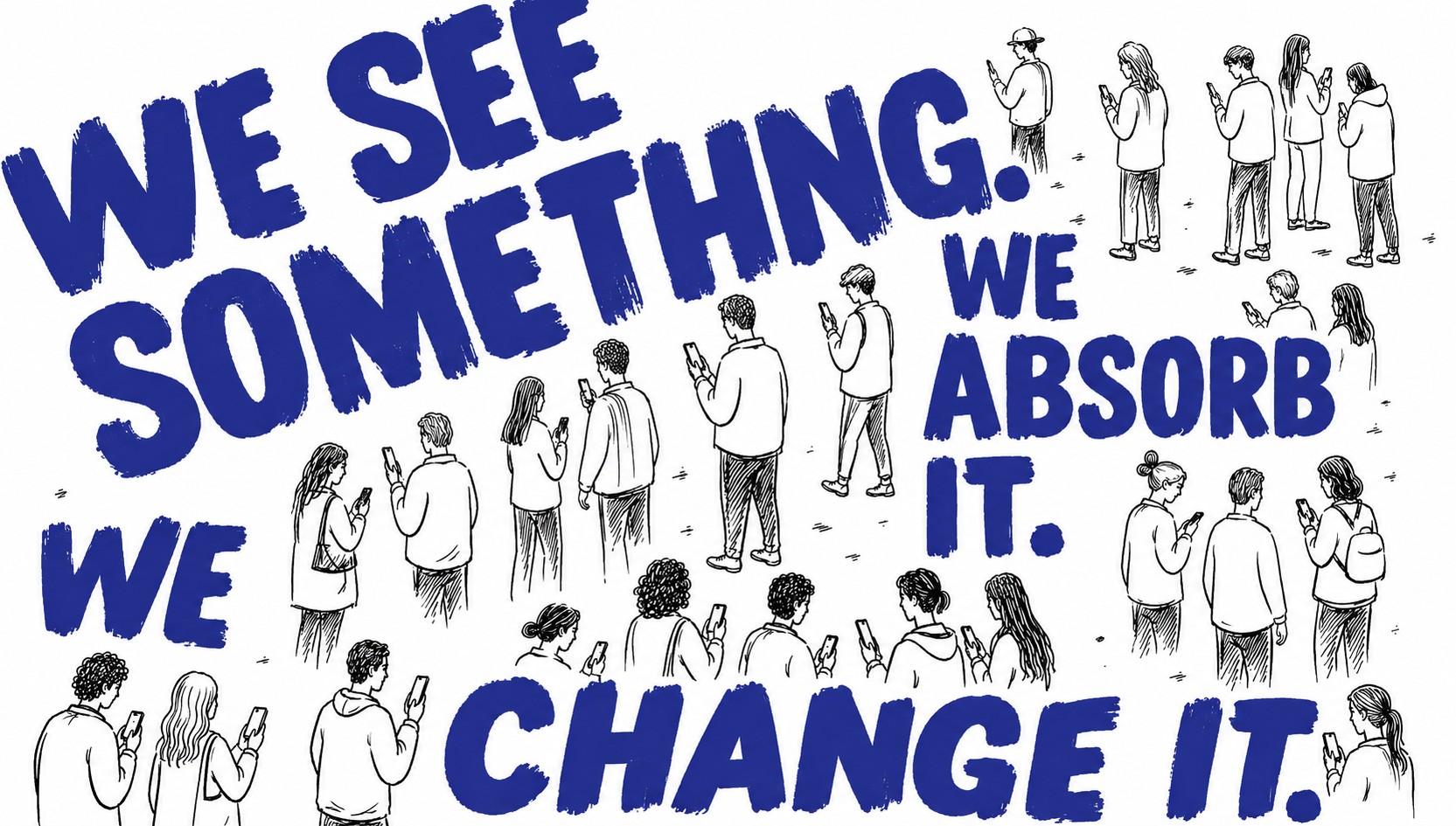
    We see something.
    We absorb it.
    We change it.

    We combine it with something else. Then somebody sees what we have made and the process begins again.

    There is something quite comforting about that.

    But lately I’ve been wondering whether iteration has changed.


    Iteration used to have friction

    Before the internet, influences travelled relatively slowly.

    You might discover an artist through a book. Hear a new band through a friend. Find an unusual magazine in a shop. Visit another country and notice a completely different visual language.

    Those influences would get mixed together with where you lived, the people around you, what you could afford, what materials were available and your own ability.

    Copying was never perfect.

    And perhaps those imperfections were important.

    If ten people tried to recreate the same thing, they would probably produce ten slightly different results.

    Something would inevitably be lost, misunderstood or changed along the way.

    Perhaps that’s actually where originality lives.

    Not necessarily in creating something from nothing, but in the distance between the original idea and our imperfect interpretation of it.

    The gaps in our knowledge created variation.

    Now we can see almost everything, instantly.

    And everybody else can see it too.


    The algorithmic iteration

    Spend a little time on Instagram, TikTok or Pinterest and you can watch iteration happening at enormous speed.

    Someone makes something interesting.

    It performs well.

    Someone else notices.

    They make their version.

    That performs well too.

    Soon there are hundreds.

    The same photographic styles. The same interiors. The same graphic design. The same video edits. The same clothes. The same restaurants. The same coffee shops. The same phrases. The same personal brands.

    Eventually it becomes difficult to work out where the original idea came from.

    Maybe that doesn’t matter.

    What interests me more is what happens next.

    The platforms learn that we like this thing, so they show us more of this thing.

    We see more of it, so we become more familiar with it.

    Familiarity becomes preference.

    Preference becomes demand.

    And demand creates more of the thing.

    It is iteration feeding iteration.


    Then brands arrive

    Of course, brands understand this.

    If enough people begin presenting themselves in a particular way, there is an opportunity to sell them the things required to complete the picture.

    The right trainers.

    The right coffee machine.

    The right furniture.

    The right car.

    The right phone.

    The right holiday.

    Even the right houseplant.

    Products have always been marketed through aspiration, but social media has made the feedback loop extraordinarily efficient.

    We don’t just see advertising from brands anymore. We see thousands of people demonstrating the lifestyle surrounding the product.

    And because those people are also watching each other, certain lifestyles begin to converge.

    The strange part is that something can feel incredibly personal while being shared by millions of people.

    This is me.

    But where did me come from?

    How much did I choose, and how much was gradually presented to me until it felt like a choice?


    Is originality even possible?

    Perhaps we’ve put too much value on originality.

    The idea of creating something completely untouched by previous influence might be impossible.

    Every drawing I’ve ever made is influenced by drawings I’ve previously seen. Every website I’ve designed contains decades of established conventions. Every piece of code I’ve written relies on ideas developed by other programmers.

    Even rebellion requires something to rebel against.

    Punk needed what came before punk.

    Modernism needed what came before modernism.

    The avant-garde needs a garde.

    Trying to completely escape iteration might therefore be pointless.

    We would have to somehow forget everything we’ve ever seen.

    And even then we’d still have nature.

    Patterns, symmetry, repetition, rhythm, growth, decay.

    Iteration seems to be everywhere.


    Maybe the problem isn’t iteration

    Maybe it’s convergence.

    Iteration should create branches.

    One idea becomes two. Two become four. Four become hundreds of strange variations.

    Imagine an idea travelling slowly between people, places and disciplines.

    A painter sees something in architecture. A musician sees the painting. A fashion designer hears the music. A graphic designer sees the clothes. Each person takes something different from what came before.

    By the time the idea reaches the end of that chain, it might barely resemble where it started.

    That’s iteration doing something interesting.

    But what happens when everybody sees the same source at roughly the same time?

    We don’t necessarily get branches.

    We get thousands of people iterating from the same reference point. And increasingly, the platforms distributing those references are measuring the response.

    Likes. Views. Shares. Saves. Watch time. Clicks.

    Successful iterations are amplified. Unsuccessful ones disappear.

    The next person isn’t simply responding to an idea. They’re responding to an idea that has already been tested and ranked.

    That changes the process.

    Iteration starts becoming optimisation. And optimisation is very different from exploration.

    Instead of asking:

    What could this become?

    we begin asking:

    What version of this is most likely to work?

    That’s an incredibly useful question in many situations. But I’m not sure it’s always a particularly creative one.


    The value of getting it wrong

    I’ve become increasingly interested in processes where I don’t completely control the outcome.

    Generative art is an obvious example.

    You create the rules, but you don’t necessarily create the final image. You might define a grid, a set of colours, a movement system or a mathematical relationship. Then randomness enters the process. Run the same piece again and something changes. Run it a hundred times and occasionally something appears that you wouldn’t have consciously designed.

    I find that fascinating.

    Because in a strange way, the computer is introducing some of the friction we’ve been removing elsewhere.

    The unexpected result becomes part of the creative process. And it doesn’t have to involve code.

    It could be paint running somewhere you didn’t expect. A photograph being badly exposed. A material behaving differently from how you imagined. Mishearing a lyric. Picking up the wrong pen.

    Some of the most interesting iterations happen because something went wrong.

    Perhaps creativity needs a certain amount of information loss.

    A gap between the reference and the result.


    Deliberately introducing imperfection

    Perhaps one way out is to introduce that friction ourselves.

    Do something without researching it first. Use the wrong tool.
    Work with a material you don’t completely understand.
    Listen to music outside the genres recommended to you.
    Buy the strange magazine.

    Visit somewhere without searching for the ten things you’re supposed to see when you arrive.

    Make something and don’t immediately compare it with what other people have made.

    Allow randomness into the process. Allow mistakes. Allow bad ideas to survive slightly longer.

    Because sometimes the interesting part of iteration is the mutation.

    The misunderstood instruction. The accidental mark. The badly remembered reference. The technical limitation. The thing that wasn’t supposed to happen.

    Those are often the moments when an iteration stops being a copy and starts becoming something else.


    But do we actually want to escape?

    There is another possibility.

    Perhaps we don’t.

    Humans have always copied each other.

    It helps us communicate. It creates culture. It allows ideas to spread. It gives us common visual languages, rituals, music, fashions and beliefs.

    Iteration is how knowledge survives. If every generation started again from nothing, we’d get nowhere.

    So I don’t think iteration itself is something we need to escape.

    What might be worth escaping is unconscious iteration. Following because everyone else is following.

    Buying because everyone else is buying.

    Designing something a certain way because that’s what design currently looks like.

    Making something because the algorithm has quietly demonstrated that this is the sort of thing that gets rewarded.

    Maybe the important thing is simply to notice when it’s happening.

    To occasionally ask:

    Where did this idea come from?

    Why do I like this?

    Would I still make this if nobody else was going to see it?

    What happens if I deliberately take it in the wrong direction?

    We probably can’t escape iteration.

    I’m not convinced we should.

    Maybe we just need to put a little friction back into it.

    Enough randomness, misunderstanding, curiosity and failure to stop every branch growing in the same direction.

    Because perhaps originality isn’t the absence of influence.

    Perhaps it’s what happens to an influence on the journey.