There’s something wonderfully low-tech about watching a solar eclipse through a cardboard box.
I remember being at school in the 80s and 90s and making simple pinhole viewers — cardboard boxes, a tiny hole and an image of the Sun projected safely onto the inside. No screens, no apps, no live streams. Just a little glowing circle of light and the slightly strange feeling that something unusual was happening above us.
With another solar eclipse arriving on Wednesday 12 August 2026, I wanted to revisit that memory, but through generative art.
A digital pinhole viewer
The idea for this project is deliberately simple.
The entire sky is constructed from a grid of tiny dots. In the centre, brighter yellow and white dots form the Sun, while shades of sky blue create the surrounding atmosphere.
Rather than drawing recognisable clouds, slowly moving noise passes through the grid. It creates subtle areas of light and shade that drift across the image — more like changing atmospheric conditions than illustrated clouds.
The dot-matrix appearance is a little nod back to available technology back then. The image isn’t trying to reproduce the sky perfectly. It’s reducing it to light, dark and a grid of tiny marks.
Following the real eclipse
The project has two modes.
Simulate compresses the entire eclipse into a short animation, allowing me to experiment with the effect at any time.
Live is the more interesting one.
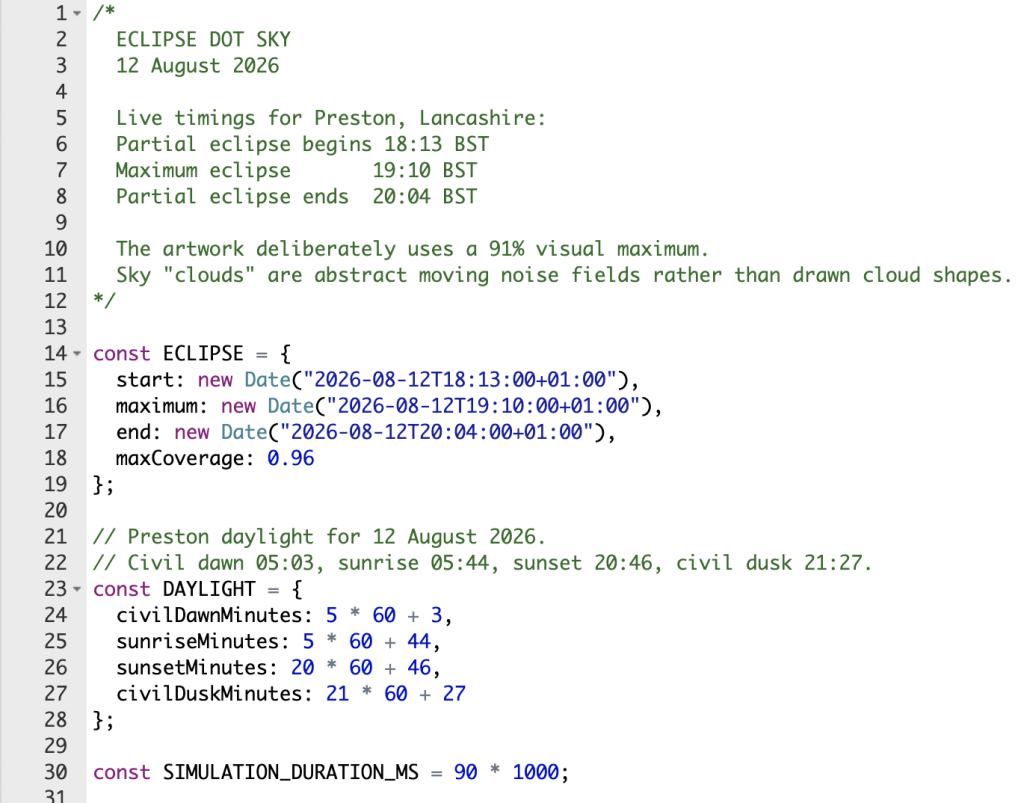
On 12 August, the artwork follows the actual time of day and the progression of the eclipse. The sky begins as a light blue around #87CEEB, gradually changes with the natural daylight, and becomes darker as more of the Sun is obscured.
As the Moon moves across the Sun, its dots are progressively swallowed by the darker grid. The surrounding sky responds at the same time, before gradually becoming lighter again as the Moon moves away.
Because the eclipse is happening towards the evening, the natural transition towards sunset is happening at the same time. The two systems overlap: the real day is getting darker while the eclipse temporarily makes it darker still.
Taking the cardboard version with us
The digital version won’t be our only viewer.
We’ll be heading to Moor Park in Preston with our pinhole box viewers to watch the real thing.
A free community viewing event starts at 5.45pm, with astronomers from the University of Lancashire and Preston and District Astronomical Society bringing specialist equipment and eclipse glasses so people can observe it safely.
It’s being billed as the UK’s deepest solar eclipse in over a decade, with the Moon covering up to 96% of the Sun in parts of the UK.
So while there will be plenty of sophisticated astronomical equipment pointing towards the sky, I quite like the idea that we’ll also be standing there with a cardboard box.
Some technology is difficult to improve upon.
And somewhere nearby, my devices will be doing essentially the same thing — turning the Sun into a collection of little dots and watching them disappear.
Watch my live simulation here